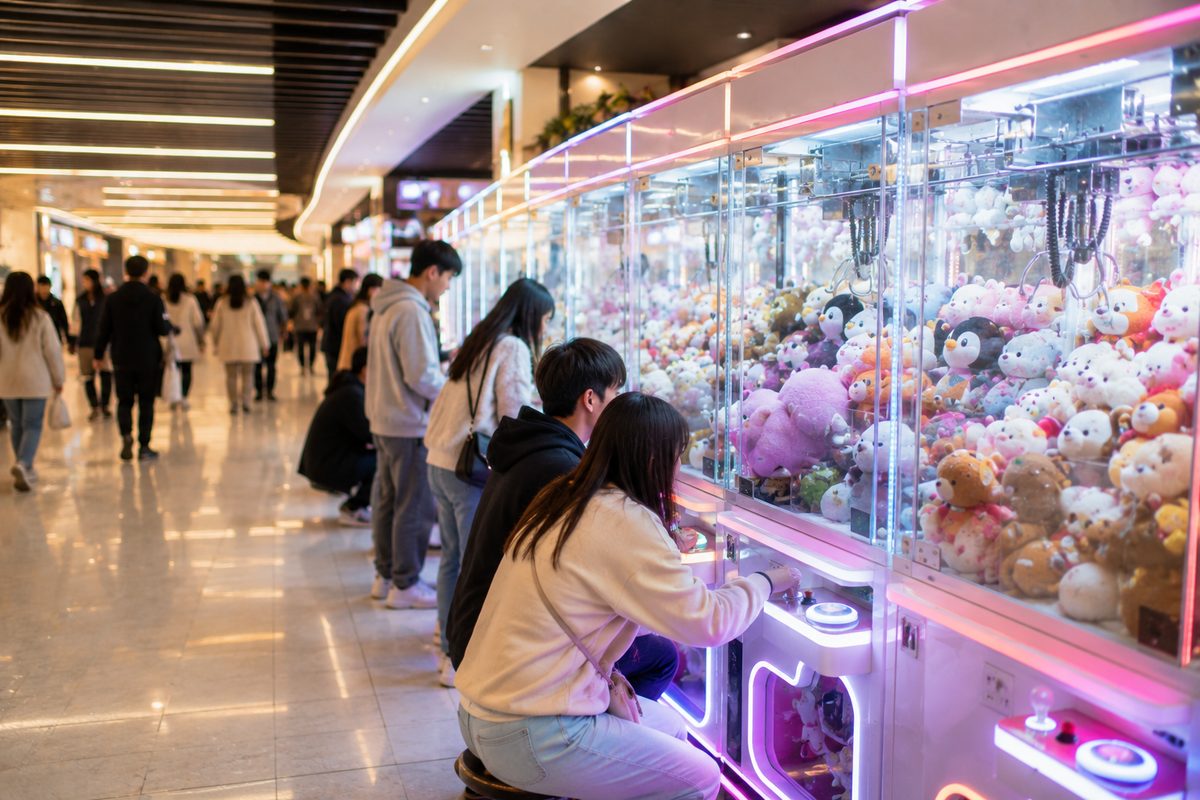
Claw machines are having a real moment, and it’s showing up in commercial real estate data, not just nostalgia posts. Landlords are actively seeking out claw arcades to fill vacant space, chains are franchising to keep up with demand, and the growth is fast enough that real estate trade press is now covering it the way it once covered fast-casual restaurants.
What the real estate data shows
CoStar News, the commercial real estate trade publication, reported in July 2026 that claw-machine arcades are grabbing up US retail space, expanding from niche storefronts in Asian shopping districts into malls and shopping centers. Chains have started franchising and signing leases with major landlords, with recent openings at Simon Property Group and Unibail-Rodamco-Westfield properties, including a debut at Mall of America in Minnesota.
James Cook, director of research for JLL’s retail division, told CoStar that location-based entertainment, the broader category that includes trampoline parks, escape rooms, and claw arcades, has become a primary retail tenant category that drives traffic at shopping centers. That’s a meaningful shift. A few years ago, claw machines were an amenity tucked into an existing arcade. Now they’re a lease-signing tenant category landlords chase on their own.
The appeal for landlords is practical. Nicole Larson, Colliers’ national manager of US retail research, described claw arcades as an easy way to fill a 500 to 1,000 square foot vacancy that’s been hard to lease, since there’s minimal buildout cost and low ongoing operational overhead compared to a typical retail tenant.
The Asian pop culture wave is real, and it’s not new anymore
Part of what’s driving demand is the mainstreaming of Asian pop culture in the US, from collectible plush characters like Labubu to K-pop and anime. Larson told CoStar that Americans have moved from being closed off to Asian brands a few years ago to fully embracing the culture, food, and products that come with it. Claw arcades, long a fixture of Japanese, Korean, and Taiwanese street corners, are riding that wave into American malls.
This isn’t a one-year story. Operators quoted in the CoStar reporting describe a sector that’s still fragmented, with no single national leader yet, which suggests the growth curve has room left rather than being close to a peak.
Nostalgia plus a genuinely social activity
There’s also a simpler explanation: claw machines are one of the few arcade staples that never fully went away, and the current wave is pairing that nostalgia with an experience that’s hard to replicate online. Kevin Soulivong, director of operations at claw arcade chain Kako Claw, put it directly to CoStar: people can buy a plush toy online in one click, but they can’t buy the win itself, or the reaction from friends watching it happen.
Industry coverage from family entertainment operator Stars and Strikes points to a related shift in the format itself. Today’s claw arcades favor cleaner, brighter, more curated spaces than the dim corners claw machines used to occupy, with card payments replacing coin slots and rotating prize selections designed to bring people back rather than a single static prize wall.
Social media is doing free marketing for the format
NBC’s TODAY show covered the trend directly in July 2025, describing what it called “clawcades” popping up across the country as part of a broader arcade resurgence. CoStar’s reporting makes the same point from the landlord side: claw machines are getting a real popularity boost from TikTok and Instagram, where a win is inherently shareable content. An operator doesn’t have to buy that exposure. It happens because the format is built for a phone camera.
The trend has produced a real content economy, and real operators
The Hustle, the business and tech publication, reported in January 2026 on how claw machines have become both a social media phenomenon and a legitimate small business. The piece profiles creators like Erik Kane and Matt Magnone, whose YouTube channels built audiences in the millions filming claw machine plays, and Jack Ennis, an operator in Melbourne who owns and runs around 40 machines across trampoline parks, play centers, malls, and restaurants.
Ennis’s numbers are worth noting because they’re concrete rather than speculative. According to the reporting, a single claw machine typically costs $500 to $1,000, can pay back that investment in four to six months, and can earn an operator $200 to $400 a week after that. Ennis’s own summary of the business: “It’s very scalable and profitable.”
Ennis runs an independent operating model, not a host-placement arrangement like Stuffie Squad’s, so his numbers describe machine-level economics rather than what a host business earns. What his experience does confirm is something the Alabama-specific data can’t: claw machines generate real, sustained revenue at the individual-machine level, in multiple countries, across several different venue types. That’s a useful check against the idea that this is purely a social media fad with no economic substance behind it.
A word of caution, because hype cycles are real
None of this means every claw arcade concept will still be around in five years. CoStar’s reporting is direct about this: the retail landscape is full of concepts that expanded fast and then faded as tastes moved on, and claw arcades are not guaranteed to be different. What’s notable is that the operators themselves acknowledge this rather than dismissing it, which is a reasonable sign that the growth is being taken seriously rather than treated as a sure thing.
What this looks like at a smaller scale
The trend coverage focuses on mall-scale chains, but the same logic applies at the level of an individual restaurant or family business, which is where placement models like ours operate.
The Claw Daddy, based in Roswell, Georgia, runs a placement model built specifically around restaurants: claw machine rentals, prize selection matched to the host’s clientele, and ongoing maintenance handled by the operator rather than the restaurant. It’s a direct example of the same basic idea Stuffie Squad runs on, applied in a different metro.
AttyCat’s Arcade in Inlet Beach, Florida, shows a slightly different version of the same pattern. It’s a family-owned arcade, open since 2023, built into the 30Avenue retail center alongside Great American Cookies and Marble Slab Creamery, combining games, including claw machines, with the kind of dessert business families already visit. That pairing, games plus a treat-focused host business, is close to what Stuffie Squad is doing at Neighbors West Homewood, an ice cream parlor in Homewood.
Neither of these businesses is affiliated with Stuffie Squad. We’re citing them because they show the same underlying idea working in other markets: pair a claw machine or arcade experience with a business families are already walking into.
What this means for Alabama business owners
The national trend is landlords and chains. The local version is simpler: a family-friendly business with some open floor space can add an experience customers are already primed to want, without buying equipment, managing maintenance, or taking on new staff work. That’s the placement model in miniature, and it’s why we think the timing for Birmingham-area businesses is good rather than late.
If you’re weighing whether this fits your business, the practical next step is how claw machine placement actually works, or you can reach out directly through Partner With Us.
Curious if this fits your business?
A conversation costs nothing. Tell us about your space and we'll walk it with you.
Partner With Us